Facing Danger with Friends

In class today we briefly touched upon how Tolstoy believes that there are two ways that people react to danger.

“At the approach of danger, two voices always speak with equal force in a man’s soul: one quite reasonably tells the man to consider the properties of the danger and the means of saving himself from it; the other says still more reasonably that it is too painful and tormenting to think about the danger, when it is not in man’s power to foresee everything and save himself from the general course of things, and therefore it is better to turn away from the painful things until they come and think about what is pleasant. In solitude, a man most often yields to the first voice; in company on the contrary, to the second” (745).

It may initially appear that Tolstoy has only recently been building towards supporting this statement, mainly through the seeming nonchalance that the attendees of the various groups in Moscow regard the war. However, this view of human nature is actually visible even earlier in the book.

One of the earliest moments in which we get to see someone react to danger is Nikolai Rostov charging with his unit to set fire to a bridge in order to deny the French an easy river crossing. You may remember that Nikolai, while seemingly quite sure of himself and the glory he will earn beforehand, becomes entirely ineffective and indecisive as soon as he rides into danger. In fact, it is described how he “looked at this enemy and wanted to run further”, putting himself in even more danger, resulting in one of the officers shouting at him to get back into cover (147). This in fact entirely supports Tolstoy’s view. Nikolai had spent essentially all his time leading up to the charge with his group of soldiers, and thus did not feel concerned about the coming danger. However, as soon as the danger is actually present, he folds like a house of cards.

Interestingly, Nikolai continues to follow a variation of this pattern even once he has become used to the danger of fighting. Earlier in the scene wherein Nikolai leads a counter charge into the charging French horsemen, he is described as, rather than being frightened, instead invigorated by the sounds of bullets whizzing by. This seems to be a logical extension of Tolstoy’s thought process. Instead of awakening to the danger once it is in front of him, Nikolai continues to be oblivious, as this leaves him much happier. It could even be argued that one of the reasons he is so knocked off balance by wounding the French horseman is because it forced him to realize that he himself could in fact be injured. Additionally, in both of these scenes Nikolai is in perhaps one of the biggest unified groups of them all: an army. The strong relationship between soldiers can be seen both with Andrei and his troops, showing it is possible for the common soldier to form a bond with a prince, as well as with Denisov, who seizes a supply transport destined for another part of the army in order to feed his own troops who “haven’t eaten for two weeks” (399). If Tolstoy believes that being in a group is enough to push away the consideration of danger, then the army would surely be one of the best groups to do so.

Other characters this effect can be seen in include both Andrei and Tushin, the officer in charge of the cannons at the battle of Schöngraben. At said battle Andrei never fears for his life, and instead views the whole experience as a way to finally have his moment to excel and be recognized as above the rest. The reason he never feels in danger is because he never actually is directly confronted by it, and instead spends most of his time with the commanding officer or riding up and down the lines, thereby remaining a part of the group. Tushin is an even more extreme example. At one point Tolstoy remarks on how Tushin was left unaware of how the soldiers screening him from the French had left their positions, emphasizing how either brave or foolhardy, depending on your perspective, he was by remaining in place. Yet again, this could be explained by how Tushin, in addition to being left fairly battle crazed by the whole experience, though he was surrounded by allies and thus felt secure.

Overall, Tolstoy does not appear to be an author who states an opinion without truly believing it, since his belief about how people face danger is present essentially throughout all that we have read.

A Load of Hot Air

Throughout the descriptions of conflict, we have been introduced to standard artillery, cavalry, and infantry. I assumed this would be the extent of military forces covered, but out of the blue, a wonder weapon was introduced. I never considered air power a factor in any major conflict before World War I but was surprised to see the appearance of a hot air balloon in the midst of war in 1812. Pierre briefly introduces us to “…the big hot-air balloon that was being constructed by Leppich to destroy the enemy…it was being constructed at the wish of the sovereign”(751) but it has not been mentioned again. After some external research, I found that just like the brief mention, the lifetime of this balloon was also short-lived and the project was scrapped. It was the brainchild of Franz Leppich who sought to make a machine that would be able to decimate the French from the air by dropping explosives. Hot air balloons were not a new invention, but used by French forces before for enemy observation and signaling. However, they could not be reliably moved and steered. Leppich sought to make add maneuverability to the equation. His insane plan for maneuvering through the air would be with rowers and paddles, similar to those you would find on a boat. The German inventor first proposed his idea to the French, but was ridiculed and ultimately expelled from France. When turning to the Russians he developed the vehicle on an estate near Moscow in secrecy leading to false rumors to be spread about the government activity. These presumptions ranged from the making of plows to the development of a submarine. However, with the war of 1812 continuing, Napoleon pushed closer to Moscow and Leppich continuously missed deadlines for flight and had failed flights. He used taffeta silk which leaked too much to be useful and planned for an airship made of heavy wood to be chock full of guns, explosives, and 50 men. When doing a final test before Napoleon arrived the balloon failed to lift off the ground with only 5 men and only took off with 2 aboard. His project was scrapped and destroyed before Napoleon arrived after it was promised that this wonder weapon would save the Russian war effort.

https://www.jstor.org/stable/125276?seq=5#metadata_info_tab_contents

Taking war into the skies: The age of the airship

Fact and Fiction: General Kutuzov

Tolstoy depicts General Kutuzov as a larger-than-life figure, with his abilities to draw attention and authority in a room full of military officers. Prince Andrei was fascinated with Kutuzov’s leadership: “Prince Andrei followed attentively the expression of the commander in chief’s face” (742). According to Russian history, Kutuzov is one of the most celebrated heroes in the books. And while it is certainly true that Kutuzov’s leadership had helped the Russians drive the French out, Tolstoy seems to exaggerate some of his own capabilities. “What the general on duty was saying was still more practical and intelligent, but it was obvious that Kutuzov despised both knowledge and intelligence…He despised them with his old age, with his experience of life” (742).

Russian history books call the general “One-eyed Kutuzov”, after his eye was shot out during battle. He was known for leading from the front lines of battle, unlike many other high-ranking officers. He would eventually be shot through the temple of his head again. This reputation of a fearless military hero is what Tolstoy may be trying to capture in the novel. He writes that the general did not like planning for battles; he liked to fight the enemy using his “experience” instead.

While it would be amazing if someone could really win wars with improvised tactics, Kutuzov was better known for his military strategy. In the French invasion of Russia, the general learned that he was not able to fight Napoleon’s army in a large battle. His own army was too small for a head-on match. So instead, he devised a strategy to fight the outskirts of the French army in small skirmishes. His long term plan was to stall the French army from moving forward and to break morale. He wanted to wait until the winter to fight large battles. This strategy worked especially well when the French invaded Moscow in September of 1812. Napoleon could not move his army, as provisions were getting low. Upon learning this, Kutuzov decided to engage the French in small skirmishes. Eventually, December rolled around, and the cold winter forced Napoleon to retreat. This would later become a defining moment in Russian history and a source of national pride for driving away Napoleon.

General Kutuzov was a brilliant strategist who actually wanted to be practical and intelligent about fighting wars, unlike Tolstoy’s fictional claims. Through Prince Andrei’s perspective, Kutuzov was a herculean figure, and it went well with the plot of the story. Even with the historical inaccuracies, Tolstoy’s version of Kutuzov is better anyways.

Sources: warfarehistorynetwork.com, Wikipedia

Influence Culturelle


The Napoleonic Wars revealed to the Russian nobility their lack of individuality, just as I had hoped. But, I was surprised to see the consequences that language endured because of this result. The wealthy characters of War and Peace characters are willing to accept the fines for speaking French. Maintaining their image is important to them, and, regardless of the war, French culture is still considered the pinnacle of high society. Traditional Russian dances and songs, such as the ones Natasha performed, were viewed as those of the poor and uncultured. When war broke out, the nobility was forced to reject the customs they had come to accept as their own in favor of a patriotic spirit that was foreign to them. They found their native language “boring—impossible to speak!” (748), not knowing how to express themselves in Russian, asking “how do you say it in Russian?” (749). Wartime poet Denis Davydov noted that Russian officers were “mistook for the enemy because of their foreign accent in Russian”. The attachment and faithfulness to French language and culture could not have developed over a series of years. It is evidence of an earlier, prolonged influence. So, when and why did French culture begin to seep into Russian culture?

The answer lies in geography and cultural thinking and application of education. Comparatively, France lies in a much more dynamic geographic region than Russia. This allowed France’s economy to expand beyond an agriculturally dominant economy. Even in 1812, Russia continued to employ a system that mirrored Middle Age Feudalism. Peter the Great saw Russia falling further behind it’s neighbors who were beginning to industrialize and sought to change that. Ironically, by inviting foreign aid to help Russia modernize throughout the 18th century, Tsar Peter is largely to blame for France’s pervasive cultural influence. While aid came from all over Europe, the most widely available and prolific texts and literature were French. French tutors often discouraged their students from speaking Russian. Russia was playing catch up for most of the 18th century, and it believed that the easiest and quickest way was to reject its own identity. After Peter allowed foreign influences in, French influence peaked with the ideals of the Enlightenment: namely the works of Baron Montesquieu, Jean Le Rond d’Alembert, Voltaire, and Denis Diderot had impacts in Russia. Catherine the Great continued to allow French influence leading up to the French Revolution. A combination of Russia’s dire need to modernize and its prolonged exposure to radical and liberal French ideals of enlightenment created a foundation for French culture to thrive among the nobility.

https://www.rbth.com/politics_and_society/2017/05/25/why-was-french-spoken-in-russia_770185

https://www.guggenheim.org/arts-curriculum/topic/age-of-peter-the-great

How genuine was the Old Prince’s apology?

“‘Thank you… daughter, dear friend… for everything, everything… forgive me…thank you… forgive me…thank you!…’ And tears flowed from his eyes” (2.2.8)

The Old Prince has some sort of transformation of perspectives near the end of his life. As he lays on his deathbed, there must be a million thoughts racing through his head, yet he ends up using his precious time to apologize to Marya. I sincerely wonder how genuine he is being. Is he sincerely appreciative and regretful towards Marya, or is he just saying these things to clear his conscience? In my opinion, it is a mix of both.

Although it is hard to believe, I do feel that the Old Prince did love Marya. He made her life absolutely miserable, and he was incredibly selfish. Yet, I feel that his actions also had a slight tinge of caring for her. For instance, when Marya was courted by Anatole, the Old Prince was firmly against this. Whether it was because he selfishly wanted to keep Marya to serve himself or if it was because he did not want to lose her, it is completely up to your interpretation. Despite the lack of concrete and direct evidence illustrating his love for Marya, I feel that the Old Prince did at least care for her a bit, partially leading to his apology.

On the other hand, he was also feeling the need to clear his conscience. I am sure during his dying days, he was heavily reflecting on his life. It must have crossed his mind that he had truly wronged Marya, prompting his apology. Although he understands his mistake, I do not think that he truly regretted it. If he was given the chance to repeat everything, I doubt he would treat Marya any better. Ultimately, I feel that the Old Prince’s apology was spurred primarily out of a need to ‘fix his karma’ with slight motivations from his sincere love for Marya.

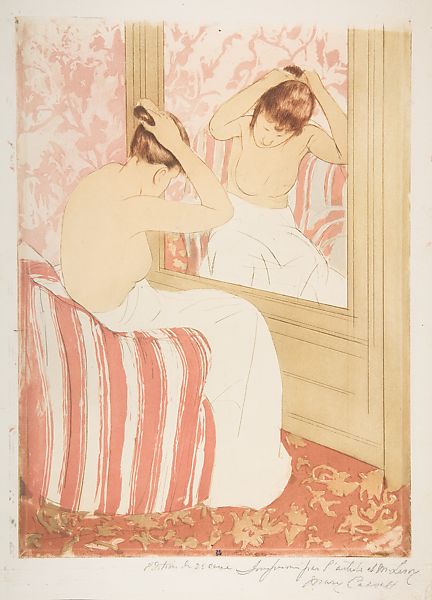
“La Coiffure”

restricted

“La Coiffure,” the hairstyle, refers to the ritual of “grooming, dressing, and preparing one’s hair” that was made popular in the seventeenth and eighteenth century days of Marie Antoinette and was passed down into the nineteenth century as an ideal of femininity and beauty. This process of getting ready represented not only one’s beauty, but also wealth and status, as maids were needed to help with one’s hair.

This past week in art history we had a work titled “La Coiffure” by Mary Cassatt (completed in 1891). The print depicts a partially nude woman in front of a mirror tending to her hair. Depictions of women in this setting were common, Picasso and Renoir painted similar poses. However, there are two things that make Cassatt’s piece standout: the influence of Japanese art and the presentation of the subject herself. In the 1850s, Japan was opened to Western trade and European artists were especially interested in woodblock prints, porcelains, jades, and lacquers. As demonstrated in “La Coiffure” elements of Japanese design became incorporated in European works. Cassatt draws influence from traditional woodblock prints, ukiyo-e’s, that depicted scenes of the upper class. In Cassatt’s print, unlike the status that usually accompanies women of La Coiffure paintings and drawings, the woman is alone in the act of tending to her hair, suggesting that she is a working woman. Additionally, there is no voyeuristic element often common in female nudes. The woman is modest and attention is drawn from her body to the overall composition, attracting our attention to line, shape, and pattern present in the rest of the piece.

So how does this relate to War and Peace? When thinking about this work I was reminded of the scene where Marya prepares to meet Anatole. Marya “[gives] herself to the power of Mlle Bourienne and Lise’ and “the two women concerned themselves in all sincerity with making her beautiful” (pg 219). The depiction of this scene mimics traditional ‘La Coiffure” depictions: Marya is a woman of high status being assisted in dressing up to meet her guests. However, in this effort to make her beautiful, nothing can be done: “They forgot that the frightened face and figure could not be changed…the face itself remained pitiful and unattractive” (pg 219). While there is not a perfect comparison between Cassatt’s “La Coiffure” and Marya, similarities can be drawn between their modesty and simpleness. As we have talked about in class, Tolstoy defines beauty with regards to emotional and mental state. While Marya is not in a good state at this moment, perhaps this stems from her father’s abuse, we see that later, in her interactions with Nikolai, that with a shift in emotion she is considered beautiful.

https://www.khanacademy.org/humanities/ap-art-history/later-europe-and-americas/modernity-ap/a/cassatt-the-coiffure


“The Theater of War”

I highly doubt it was a coincidence when Tolstoy used the phrase “the theater of war” (688). Throughout the book so far, we constantly see Tolstoy flip flop between “war” and “peace” times, battle versus ballroom scenes. This frequent comparison clearly draws parallels between these seemingly contrasting yet actually quite similar scenarios. Namely, the closest scene we have had to theater, the Opera scene, mirrors many of the characteristics of war. In particular, we see Tolstoy frequently dismiss “military genius”: the calculated, skillful decisions made behind a curtain that realistically are never played out on the battlefield due to the many other unpredictable factors at hand. While Tolstoy most often uses male characters to illustrate his disgust for military genius, he seems to also use Natasha and the opera scene to demonstrate his distaste for war.

“She was unable to follow the course of the opera; she could not even hear the music: she saw only painted cardboard and strangely dressed men and women, who moved, talked , and sang strangely in the bright light; she knew what it was all supposed to represent, but it was all so pretentiously false and unnatural that she first felt embarrassed for the performers, and then found them ridiculous” (561)

In this scene, Natasha is at the opera and is bewildered by all of the sights and sounds of theater. What Natasha struggles to grapple with in this scene, is how any of this obviously manufactured realm is supposed to mimic reality. Natasha focuses on every small detail that, to her, seems garishly unreal: painted cardboard settings, unusual costumes, and the bright lights. However, Natasha is only able to see these props for their formal qualities; the cardboard is just cardboard, not a lovely forest setting. The singing is unnatural, just as the clothes are as well. Natasha critiques this calling it “pretentiously false[,]…unnatural[,]… [and] ridiculous” (561). Just as Natasha cannot seem to understand how people appreciate and even admire the unrealistic, well thought out, premeditated, and calculated plan of opera and acting, many male characters such as Andrei and Kutuzov feel the same way about war. Whereas Natasha sees right through the smoke and mirrors of opera and expresses a negative emotions toward how opera tries to remake reality in a gaudy and very forced way, Andrei and Kutuzov disapprove of the careful planning of military action. In both instances, while the subject of their disdain is different, the reasoning for their criticism is the same. All three characters seem to have the understanding that in real life, there are many tiny actions that cannot be controlled or accounted for, so in the grand scheme of things (war, theater, etc), any planned idea will not suffice. Andrei realizes that “there was not and could not be any military science, and therefore there could not be any so-called military genius” (643). Much like Andrei, Kutuzov “despise[s] both knowledge and intelligence and [knows] something else…decide[s] matters– something that [does] not depend on intelligence and knowledge” (742). Both Andrei and Kutuzov understand that in war, strategy and planning is futile. In the moment of combat, no one can anticipate precisely the sequence or execution of events. Trying to predict and recreate these heated moments of action in a conference room when plotting war strategy is completely illogical because of the desire to try and make it logical. War is not a process which can be predicted down to a tee, nor is theater able to recreate reality into a convincing and accurate fictional setting. Tolstoy uses Natasha’s repulsed reaction to the fantasy of opera to prime us for when he eventually bashes military strategy through the lenses of various military men. The ideas Tolstoy conveys during war settings and peace settings are not as different as the two antonyms of the title would suggest, and in fact both are used to further the same argument: the spontaneity of nature and reality can not be accurately recreated by man.

Villainy! Perhaps, maybe not.

Are there villains in War in Peace? In your typical fictional story, there is always a villain. Harry Potter has Voldemort (yes I said his name), Frodo has Sauron, and Sherlock has Moriarty. However, in such a vast book as War and Peace, is there anyone who can be classified as a villain? My answer…maybe.

If we think of a villain as someone who purposefully intends to ruin a hero of the story, we can’t say any one person is a villain simply because no one person is the hero. All the characters we’ve met live lives that are intertwined with one another. Sometimes they clash. Sometimes they make poor decisions, and we are left rooting for one over the other. But no one character is actively seeking the destruction of another character at every point in the book. Granted, there are exceptions. The old prince clashed with many characters before his death. Dolokhov has been known to create havoc and chaos in the scenes he appears in. Napoleon and his conquest are the very reason many of the conflicts arise in the book. However, all of these men are strangely humanised by Tolstoy at some point in the book. We witness the old prince in his last days, struggling with mortality. We are told of Dolokhov and his family after he is wounded in a duel with Pierre. Finally, we hear about Napoleon so often that we can’t put him off as simply a villain when he is so much more than that in the context of this book. So far, Tolstoy has taken time to tell us enough about these men and their lives and thoughts that we are unable to despise them fully, which brings us to the Kuragins.

Among the family of Kuragins, Anatole and Helene seem to be the most villainous. Prince Vassily is somewhat humanized as Tolstoy does with the previously mentioned characters. He acts out of his own self interest, but he still acts mostly with respect for others. His son Ippolit has been described as a moron and is mostly useless to the story (sorry Ippolit). However, Helene and Anatole are something different. Throughout the book, we do not get much insight into the minds of the two. We are shown their actions and outward appearance. But, we certainly don’t see anything that might qualify as basic human decency. Time and again we see Helene manipulate people to get her way. We’ve seen her torment Pierre and take advantage of him. And, we’ve seen her lure a happy, engaged Natasha into the grasp of her lusty, conniving brother when she saw a weakness in Natasha’s love for Andrei. Anatole is portrayed through and through as a man out for nothing but himself and his pleasure. He doesn’t care who’s in the way and who he hurts along the way. We’ve seen how he acted with Marya, with Natasha, and we’re even told of a peasant girl he married simply to sleep with her. If instead, we think of a villain as someone who does nothing but evil and wrong, then we may be able to call Anatole a villain and perhaps Helen as well. However, we cannot think of them as typical villains of fiction.

Shocking Obedience

The Milgram experiment was a psychology experiment done in 1963 to probe how “normal” people responded to commands from authority figures. The participants in the experiment, however, were told that they were participating in an experiment to test the effects of punishment on learning. When their “subject” failed to memorize a given pair of words, they were told to give the “subject” an electric shock, escalating in intensity throughout the experiment. In reality, no electric shocks were given at all and the real motive was to see whether the participants would administer lethal 450-volt shocks when told to do so by a “scientific authority.” Milgram found, shockingly, that 65% of participants were willing to continue the torture up to the highest voltages, and 100% of participants administered at least a 300-volt shock to their subject. Although fake screams of pain were being broadcast over speakers during the experiment to make the electric shocks seem real and humanize the victim, it seemed that pure authority, whether right or wrong, overruled most people’s moral senses. In fact, this experiment has been repeated many times in the psychological community, and found fairly consistent results. Interestingly, this experimental result seems to explain, or correlate to, the peasants’ blind obedience of Rostov in chapter XIV.

When Rostov goes to the Bolkonsky’s estate to find that the peasants are not allowing Marya to leave, he is furious and forces the peasants back into submission. Tolstoy explains that Rostov cried these orders “as if [they] could meet with no hindrance. And in fact, two more muzhiks began to bind Dron, who, as if to help them, took off his belt and handed it to them” (735). In this scene, Rostov effectively asserts his authority through his confident tone of voice and noble stature, which causes the peasants to immediately comply. However, in both the Milgram experiment and in Rostov’s confrontation with the peasants, the authority figure had no tangible power over their subjects. While the participants in the experiment followed morally reprehensible orders because they thought it would benefit the scientific community and because they trusted the scientific authority on the subject, Dron and the other peasants immediately moved away from their concerns because they had been conditioned to obey authority figures. I believe that this is not a reflection on the character of peasants themselves (as Tolstoy may suggest), but the moral environment in which they were raised. In the Milgram experiment, no rational human would administer lethal electric shocks to someone else unless they grew up in an ethical system that treasured scientific advancement and trusted scientific authority, even at serious costs. Similarly, if the peasants had been purely rational, they may have realized that they did not have much to fear from Rostov and continued their protest. However, because they were raised in a culture that preserves a social hierarchy, it is likely that they were already psychologically predisposed to follow orders.

Sources:

Stanley Milgram Shock Experiment: Summary, Results, & Ethics

War and Peace, by Leo Tolstoy

Single-Day Bloodbaths

The Battle of Borodino stands today as the bloodiest one-day battle in history, tying the Battle of Cannae and the first day of the Somme Offensive.

On August 2, 216 BCE, the Carthaginian general Hannibal carried out the deadliest battles of the Ancient World: the Battle of Cannae. After luring the Romans into a battle, Hannibal set up his troops in such a manner that the Roman army pushed the center of Hannibal’s line in, but the sides were kept steady, effectively making a circle of Carthaginian troops around the Roman army which Hannibal used to slaughter the Romans. Historians estimate that around 6,000 Carthaginian died, and between 55,000 and 70,000 Romans died, and an estimated 30,000 gallons of blood were spilled as Hannibal proved his military superiority over the Romans.

World War I is infamous for its heavy death toll, especially on the Western Front with the use of trench warfare. One offensive, the Somme Offensive, stands out above all others as the bloodiest of them all, where the 141 day offensive resulted in over one million casualties. On July 1, 1916, the first day of the offensive, there were around 70,000 casualties, as British and French troops ran headlong into German machine gun fire, resulting in an Anglo-French gain of 16 miles.

Coming close to, but not quite matching the death toll of the Battle of Borodino is Napoleon’s most famous battle: the Battle of Waterloo. With 65,000 casualties from both sides, Napoleon’s last battle was also one of his narrowest defeats (one of eight in his military career, out of 63 total battles). 91 days into his return from exile, Napoleon had pushed the Seventh Coalition Army to Waterloo in modern-day Belgium, where he faced a 118,000 Allied Anglo-Prussian force against his 78,000 French army.

The Battle of Borodino was fought from sunrise to sunset between the weary, diseased, and demoralised French Army and the retreating Russians on September 7th, 1812, a mere 8 miles west of Moscow. Napoleon, wishing to win a decisive victory over the Russians, pursued the Russians as far as Moscow, where, after suffering 28,000 casualties in the Battle of Borodino (as opposed to the 43,000 casualties from the Russian side he planned to camp for the winter and resume the Russian campaign in the spring. At the end of the Battle, the casualties suffered on both sides were “the equivalent of a fully laden jumbo jet crashing into an area of 6 square miles every five minutes for the whole ten hours of the battle, killing or wounding everyone on board” (Roberts, 607).

Patriotic Russian fervor, however, led to inhabitants setting Moscow on fire after Napoleon had arrived, burning half of Moscow (along with much-needed food for the 100,000+ army Napoleon had). Instead of retreating from Moscow, Napoleon foolishly tried to stay in Moscow, despite imminent starvation.

“Battle of Borodino.” Wikipedia, Wikimedia Foundation, 4 Mar. 2019, en.wikipedia.org/wiki/Battle_of_Borodino.

“Battle of Cannae.” Wikipedia, Wikimedia Foundation, 7 Mar. 2019, en.wikipedia.org/wiki/Battle_of_Cannae.

“First Day on the Somme.” Wikipedia, Wikimedia Foundation, 31 Jan. 2019, en.wikipedia.org/wiki/First_day_on_the_Somme.

Hunt, Patrick. Hannibal. Simon & Schuster Paperbacks, 2018.

Roberts, Andrew. Napoleon: a Life. 2015.

Design a site like this with WordPress.com
Get started